


CFO
Working capital, runway, leverage and the covenants nobody re-reads.
The AI-employee ERP
AI inside the ledger, not layered on top of it. Eleven AI employees run hundreds of checks across your books, your people and your stock, and agentic workflows act on what they find. You review, they work.


For businesses anywhere, launching first in Spain — where VERI*FACTU, 15 AEAT modelos and Ley 2/2023 are in the core rather than in a plugin.
VIDA26
the joy of living
Less time fighting paperwork. More time to live.
Inside the system of record
Plenty of ERPs are adding AI. What is worth asking each of them is what the AI can reach, what it is allowed to do, and what stops it. Here, each question has an answer you can check.
The crew’s findings and the assistant’s answers come from real entries and the documents behind them — not from a summary written overnight.
Meet the crew →Describe a workflow or a CRM automation in a sentence and read back real steps over your own data. Nothing runs until a person publishes it.
Agentic workflows →Anything irreversible the assistant is asked to do — post, void, file — comes back as a preview with a one-time confirmation before it commits.
L.U.C.A. →Every AI employee, agent and flow runs with a real identity, so row-level security decides what it can see and do — in the database, not in a prompt.
How access is decided →AI Crew
Each employee watches one domain under a real, non-administrative role, and files what it finds into a single per-company feed. Nothing is a chatbot; every card names a document, a figure and a decision.
Working capital, runway, leverage and the covenants nobody re-reads.
Contracts, absences, working time and the signatures about to expire.
AEAT deadlines, VERI*FACTU submissions and every modelo before it is filed.
Evidence and process — signatures, lifecycle steps, workflow bypasses.
Whether the ledger can be trusted: unposted entries, unmatched bank lines.
Bills falling due, duplicate payments and supplier concentration.
Overdue money, named customers, and a decision for each one.
Untriaged leads, stalled deals and conversations nobody answered.
What the company owns and moves — assets, stock, slow movers.
The routines: was the checklist walked, signed off, and what keeps failing.
The feed itself — whether anyone is acting on what the other ten say.

Some checks run every four hours — the VERI*FACTU ones among them, because a rejected submission you learn about tomorrow is one that sat live all day.
How the crew works →Guardrails
Every AI employee runs as a real system role with one visibility permission — never as an administrator. What it may see is what a human in that role may see, enforced by the same row-level policies, in the database, not in the interface.
Watched by
Compliance
Each employee is bound to a shipped non-admin role. Widening one to make a card work would widen it for people too.
No AI employee pays an invoice, signs a document or sends a message on your behalf. Actions need a person.
When the permission layer refuses a read, the attempt is written to the audit trail rather than silently dropped.
L.U.C.A. · AI assistant
The crew only reads and proposes. L.U.C.A. is the one you talk to, and it acts: it answers from your posted books and creates the invoice, the loan or the asset you describe — as you, with your permissions, and with a confirmation before anything that cannot be undone.

Customers, suppliers, balances and reports, read from posted entries — and only what your own permissions allow.
Invoices, bills, payments, loans and fixed assets, described in a sentence or read from the document you attach.
Post, void, file or delete comes back as a preview you confirm. Without your OK, nothing changes.
It streams as it goes, and every tool it called is listed for when you want to check.
Agentic Workflows
The work that resists automation is the work that arrives as a document — a supplier PDF, a photographed delivery note, a ticket in a shared folder. A flow puts a language model inside the process to read it, decide what it means, and hand structured fields to the next step. Every write stays a step you can see, and nothing runs beyond the permissions the flow itself has.
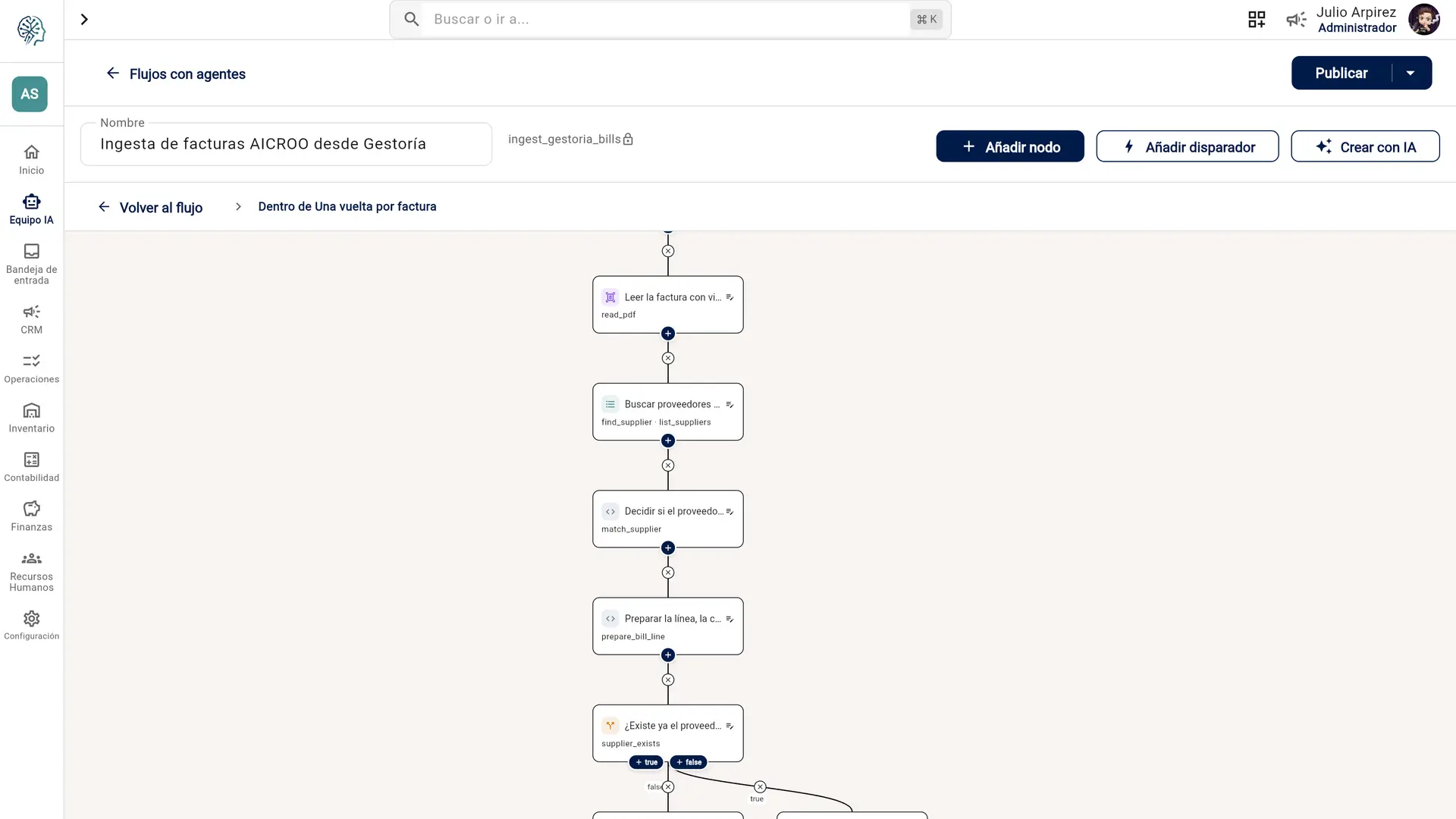
One step in the flow is a language model with a job: a prompt, the exact set of tools you allow it, and a result whose fields you declare — severity, reason, amount, whatever the next step needs.
A supplier invoice as a PDF.
Suppliers do not send things the way your process wants them.
Say what you want to happen in your own words and get a working draft back — the steps wired, the conditions filled in, pointed at your actual data.
How it works
Banks, payment rails, mailboxes and messaging channels feed one reconciled ledger.
Eleven employees run their checks on their own cadence and file what they find.
A finding triggers a flow: route it, approve it, email it, or draft the correcting document.
The systems of record
Buy the ones you need. Each is a real system of record with its own ledger, permissions and reports — not a tab in a suite.
Spanish compliance
A full VERI*FACTU pipeline with hash-chained records, QR and cancellation. 15 AEAT modelos derived from the ledger, 13 of them exported in the BOE’s own fichero layout. Facturae 3.2.2, qualified signatures to PAdES B-LTA, and Ley 2/2023 with its deadlines built in.
Watched by
Tax Adviser
What aicroo generates is a draft, meant to be checked with your gestoría or tax adviser before filing. Review, submission and ultimate responsibility for what is declared remain the user’s.
See what is covered →Payments and portals
Cards through Redsys, Revolut or Stripe, PayPal for the customers who would rather pay from their own account, and direct debit that charges without the customer present. Your customer pays from a portal that also holds their invoices and the documents waiting for their signature — and your suppliers get the mirror image, where they submit invoices instead of emailing them into a shared mailbox.
Watched by
Collections
When the processor pays one lump for forty charges, three refunds and its own fees, each line finds its invoice and the net drains against the bank — to zero, or it is not reconciled.
How getting paid works →
Electronic signature
Contracts, quotes, purchase orders and NDAs go out for signature from the record they belong to, come back sealed to PAdES with an independent timestamp, and keep an evidence trail that is chained entry by entry. Advanced signatures are sealed in-house; qualified ones run through AutoFirma with the signer’s own certificate.
Watched by
HR

Integrations
Your bank, the rails you take money through, the channels your customers write from and the tools your team already has open — connected to the ledger itself, not to a plugin somebody has to keep alive.
Banks
Payments
Messaging
Workplace
Spreadsheets
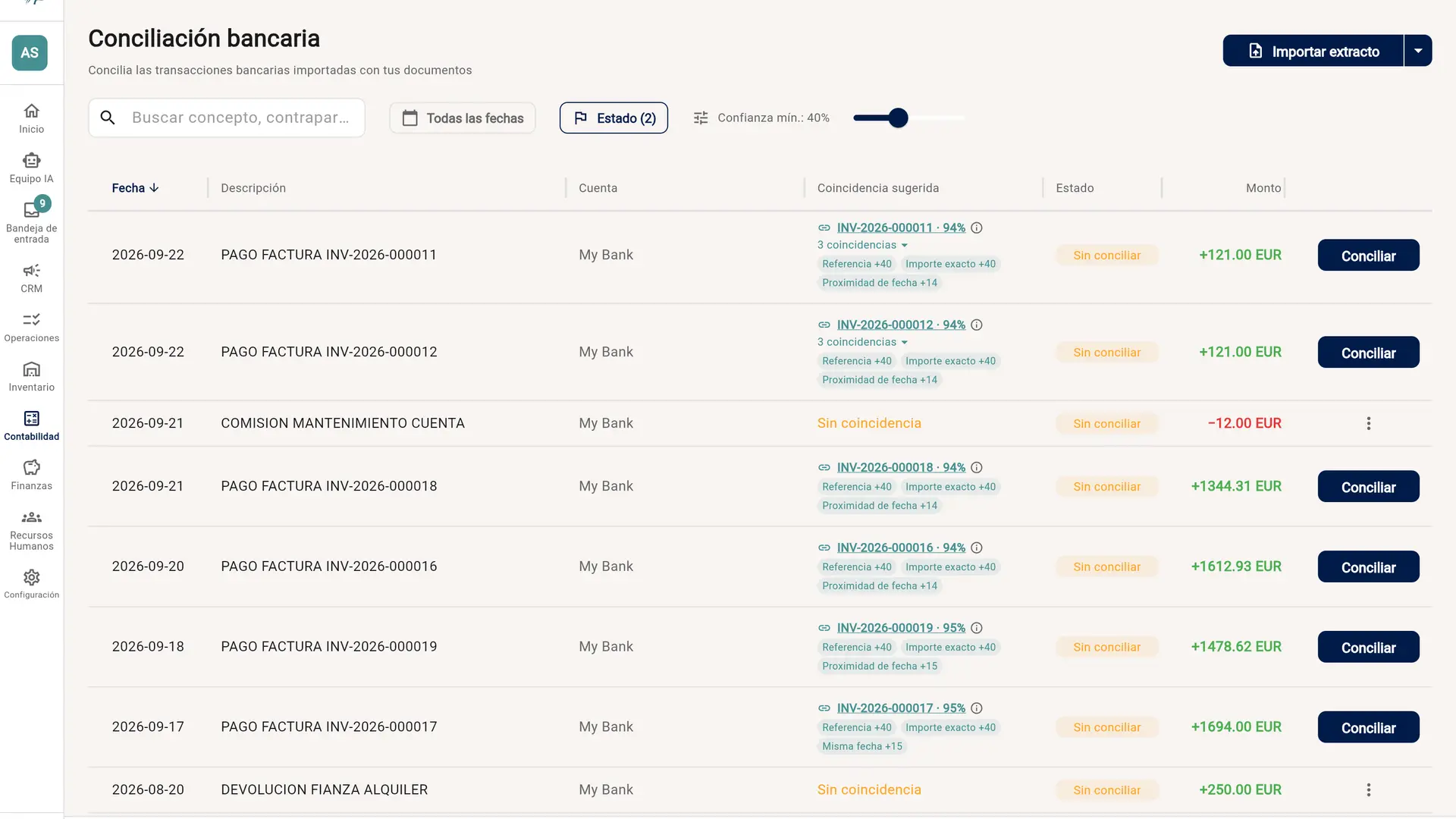
A connection is only worth having if it closes the loop. What arrives from the bank and from the processor is matched against what the books already expect — and what does not match is a short list, not a silence.
The bank
Connect the account and the statements arrive on their own; or import CAMT.053, Norma 43 or a CSV. Either way the lines are matched against what the books already expect, and what is left over is the short list worth a person’s attention.
The payouts
The lump a processor pays you on Tuesday is not one payment — it is forty of them, minus three refunds and its own fees. Each line finds the invoice it belongs to, the fees are posted, and the batch is locked: if it was wrong it is voided and reversed as one act, not by hand-editing forty settled invoices.
Developers
Every procedure in the catalogue declares whether it mutates, whether it is reversible, and which permission it needs — so an agent can be given exactly as much authority as you intend and no more.

Security
Anyone can call the API directly, so hiding a field in a screen is not security. Sensitive data is gated by row-level policies and permission checks at every layer that can return it.
87 areas at four levels — a grid somebody can read, not hundreds of loose switches.
Tenancy and authority are enforced by the database, on every read and write.
WebAuthn sign-in, and a second factor an organisation can require of everyone.
Who saw what, who changed what, and what was refused.
Pricing
Per-user where seats are the cost, flat where they are not. No mandatory platform fee, no annual lock-in to see a price.
€9/month
€7/user/month
min €25/month
€49/month
Ready to sign up? Create your account


